
Solid wood flooring is a large investment, so if your budget does not allow hardwood, consider engineered floors or laminate. Once installed they can resemble a solid wood floor. Many are extremely durable. And recently it has become harder and harder to tell the difference between the real stuff and the fake.

Engineered Hardwood
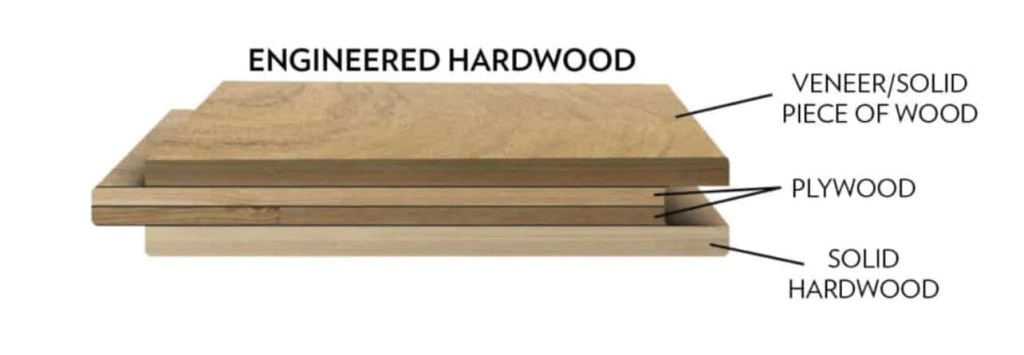
Engineered hardwood, also known as pre-finished wood flooring, consists of razor-thin sheets of wood glued together to make a plank, which is then stained most always in a polyurethane. Polyurethane is great because it is very durable to water. There are a few engineered hardwoods that are thick enough to be sanded but only once. It is smart to check with the manufacturer to confirm before sanding because most are not thick enough. Engineered is available in a tongue-in grove base that simply snaps together. This makes for extremely easy installation. Engineered hardwood comes in widths up to 7 inches. Since it is a floor covering, engineered flooring is meant to be installed on top of a subfloor. It is usually glued or nailed to the subflooring. Currently, hardscaped engineered hardwood is extremely popular. While nothing can replicate the style and elegance of hardwood flooring, engineered hardwood flooring does come close.
For your engineered hardwood flooring, you can choose from an array of wood species offering a spectrum of warm, natural colors as well as distinctive graining and textures. A company may offer maple, with its coffee-and-cinnamon coloring. Consider an exotic wood such as Brazilian koa, with deep sunset colors and streaks of dark graining. Or choose planks of natural Maple, with its light creams and subtle lines.
Laminate Flooring
Do not confuse engineered flooring with laminate flooring. Laminate is a “wood-effect” flooring. Laminate is usually constructed of a sliver of hardwood pasted onto a board, such as plywood. Some of the most inexpensive laminates use an image of wood printed on paper rather than a hardwood veneer. The boards are attached to each other with a foam or felt underlayment to help soften foot steps. Extremely easy installation. I once laid it throughout my old condo. It took a week but looked amazing. Laminate is an ideal choice for basements. It is warp proof, which makes it perfect for a room acceptable to moisture. Plastic laminate is great for wet areas or high traffic. Now a days, laminate comes in variety of sizes, finishes, and colors.

What is the key differences?
| Engineered Hardwood | Laminate | |
|---|---|---|
| Top Layer | Thin slice of Real Wood | Photo of Wood |
| Attached to a Subfloor | Nailed or Glued | None: Board attach to each other |
| DIY Self Install | Difficult | Easy |
| Core | Plywood | Fiberboard |
Which is Better?
That is hard to say. Each type of flooring have strengths and weakness. Instead it is best to analyze them by categories.
| Engineered Hardwood | Laminate | |
|---|---|---|
| Maintance | Equal | Equal |
| Appearance | Winner: Since the top is real wood | Loser: Upon close inspection it does not hold up to the appearance of real wood. |
| Comfort | Loser: Although it is sanded down to avoid splinters, this floor isn’t as cushy to walk on! | Winner: Feels almost spongy to walk on because of underlayment. |
| Lifespan | Winner: 30 years or more | Loser: 10-20 years |
| Pet Friendly | Loser | Winner: Scratch resistant |
| Cleaning | Equal | Equal |
| Resale Value | Winner: Quality and better looking | Loser |
| Basement Installation | Equal | Equal |
Resistance to wear
Not many types of flooring is good in high-moisture areas. If you need flooring for a bathroom or kitchen that sees lots of water spills, you’re better off choosing vinyl or tile flooring.
For a high-traffic area engineered flooring and laminate flooring are both good choices, as they are both durable in different ways.
Engineered Flooring
Plywood’s layers are better than laminate or even solid hardwood at resisting swelling and expansion if subjected to water. Though engineered flooring can be scratched, its veneer can be lightly sanded once to remove minor scratches.
Laminate Flooring
Laminate flooring can be laid in semi-moist environments as long as the boards are tightly seamed. If water gets between the seams, the lower fiberboard core will swell. After it is dried out, laminate flooring will not contract to its original shape.
Laminate flooring can never be sanded. Repairs are difficult if not impossible. Replacing damaged laminate with new laminate boards is usually the best course for repairs. However, laminate flooring’s top wear surface can be exceedingly tough and resilient against most daily wear, so deep scratches are rare.
Where can you install?
Engineered hardwood and laminate can be installed above grade, on grade, and even below grade. This sets it apart from solid hardwood, which is more susceptible to moisture and therefore inadvisable for basement settings. With this versatility, you could enjoy engineered hardwood and laminate in almost every room of your home.
How to Clean?
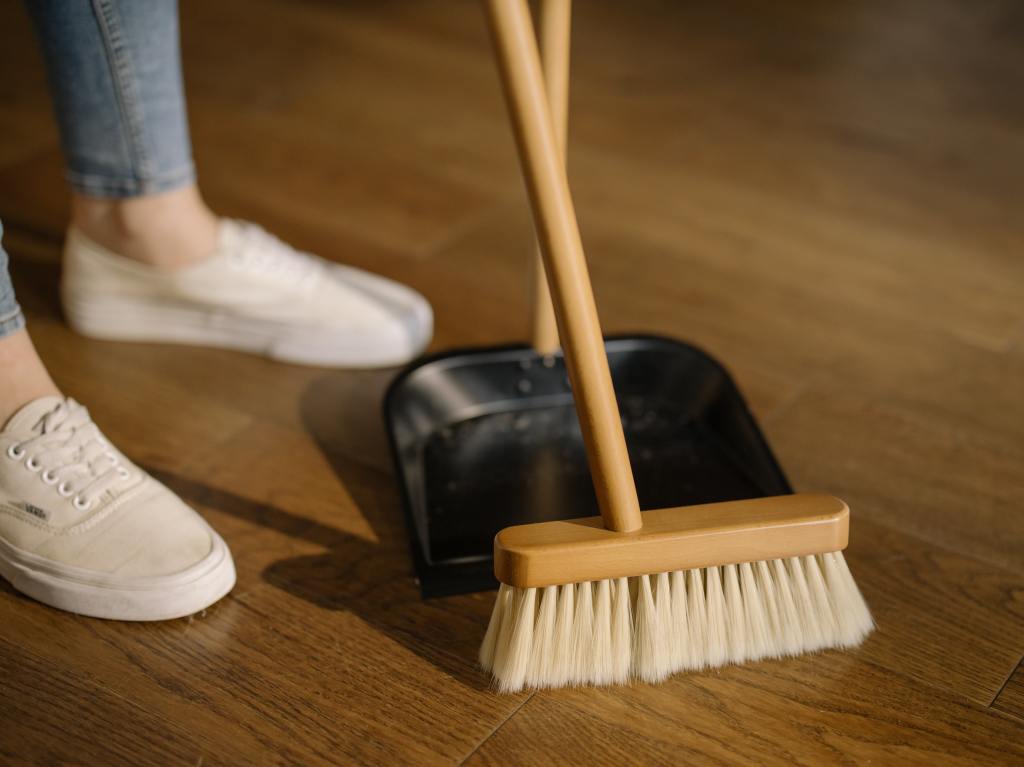
The smartest way to maintain both types of flooring is to use a dry broom or dry mop for as much of the cleaning as possible. Avoid steamers and wet mops. Never use harsh, ammonia-based cleaning products.
If you need to apply liquid to the surfaces, squeeze out the mop as thoroughly as possible until it feels nearly dry to the touch.
Cost
Engineered Flooring
- Low: $2 to $3 per square foot
- Medium: $3 to $4 per square foot
- High: $5 to $9 per square foot
Laminate Flooring
- Low: $0.50 to $2 per square foot
- Medium: $2 to $3 per square foot
- High: $3 to $5 per square foot
Top Brands
Engineered Flooring
- Armstrong
- Anderson
- Bellawood
- Bruce
- Columbia
- Kahrs
- Mohawk
- Pergo Max
- Somerset
- Tesoro Woods
Laminate Flooring
- Armstrong
- Aqua Gaurd
- Bruce
- Dream Home
- HydroSheild
- Hampstead
- Mannington
- Mohawk
- Pergo
- Quick-Step
- Shaw
- TrafficMaster
I hope this article has helped you to grasp a better understanding of laminate and engineered hardwood. If I left something out please leave it in the comment section below.
 Rban Interiors